Lee Dai-won’s luminous orchards reveal Korean modernism rooted in craft, not Europe
A major Seoul retrospective reframes Lee Dai-won's celebrated orchard paintings as rooted in Korean craft rather than European pointillism, reshaping his place in modern art history.

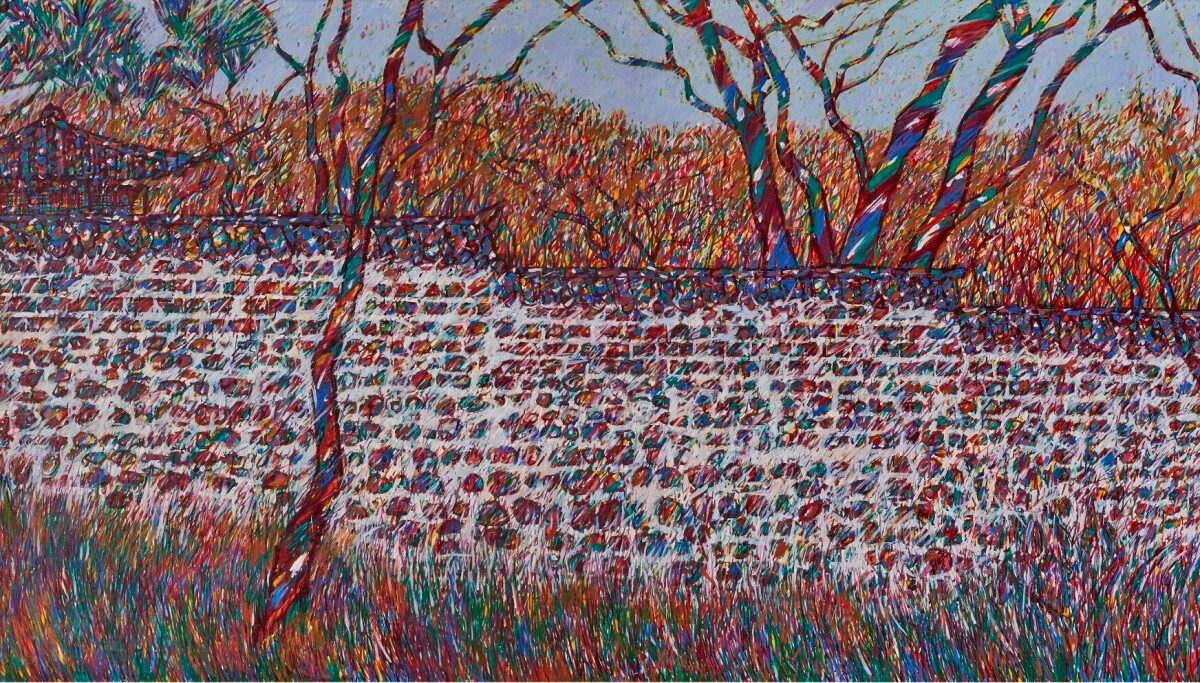
A sweeping retrospective at the National Museum of Modern and Contemporary Art (MMCA) Deoksugung is reshaping how South Korea's art establishment reads one of its most prolific but understudied painters. Lee Dai-won (1921–2005), whose influence stretched across education, patronage and cultural diplomacy, created luminous orchard paintings for over three decades — works long classified as impressionist or pointillist. The new exhibition argues they belong to an entirely different lineage.
"Nothing Here Makes You Sad," which opened on 5 August, presents 120 oil paintings and 100 archival pieces borrowed from over 50 lenders across Korea, Japan and the United States. It is Lee's first major retrospective, despite his prolific output across 19 solo shows and significant institutional roles.
The exhibition's central thesis hinges on technique and tradition. Lee's orchard surfaces are built from bright dots of pure colour laid side by side, a visual strategy that curators now trace not to Georges Seurat's optical mixing but to Korean embroidery and nacre inlay craft. "When paints are mixed, each colour disappears and what you get is an intermediate tone," explained Bae Won-jung, the exhibition's main curator. "But threads keep their own colour even when laid side by side — a red thread and a blue thread run in parallel without fusing into one. That is exactly why Lee could set dots of pure colour side by side and never have them blend."
The same principle applies to mother-of-pearl inlay, a traditional Korean craft that fixes light on a surface rather than dispersing it optically as European impressionism does. The second gallery hangs Lee's paintings alongside the embroidery, mother-of-pearl, ox-horn work and old furniture he collected — offering material proof of his sources. A wax-resisted, dyed folding screen he entered in the craft division of the 1938 Joseon Art Exhibition appears for the first time publicly, shown alongside works from the Western painting division of that same year.
Bae's research untangles a phrase Lee's contemporaries used repeatedly: "an Oriental painting made with Western paints." Rather than repeat it as compliment, she traced it to Lee's engagement with master painter Byeon Gwan-sik, whose landscapes Lee once annotated, praising brushwork, composition and textured strokes — hallmarks of East Asian painting discipline applied to oil canvas.
The exhibition refuses to flatten Lee's orchard paintings into a single late style. Compositions from the 1970s employ recession and stacked depth; 1980s canvases compress distance and stretch dots into directional lines; works after the 1990s flatten the surface entirely, erasing the far distance. "It changed continuously for 30 years," Bae noted.
The final section enlarges five- and seven-metre paintings on a mirrored floor, transforming viewing into a walk through landscape — what Korean aesthetic tradition calls wayu, or roaming whilst reclining. Here the curator's framing reaches its fullest: Lee becomes not a lucky man with a glittering career outside art, but an artist whose entire practice embodied a modernism that arrived decades before it acquired a name.