Seven Airports Are Now Designed as Destinations, Not Just Transit Hubs
Seven airports recognized by the 2026 Prix Versailles awards demonstrate how modern terminals are being designed as cultural landmarks. From a lotus-shaped canopy in Mumbai to a bamboo forest in India, these hubs blend efficient travel infrastructure with regional identity.

Seven airports across Asia, Europe, and North America have been recognized by the 2026 Prix Versailles architectural awards for prioritizing aesthetic and cultural design alongside functional travel infrastructure. The winners, unveiled in Paris on June 15, demonstrate a shift in how major transport hubs are conceived: as landmarks that reflect regional identity rather than purely utilitarian spaces.
The selection includes terminals in Guangzhou, Frankfurt, Guwahati, Navi Mumbai, Phnom Penh, Pittsburgh, and San Diego. According to the Prix Versailles judges, these airports resolve what had been seen as a conflict between high-volume travel demands and the desire to create spaces that reward visitors.
Regional References Shape Terminal Design
Guangzhou Baiyun International Airport's Terminal 3 draws from the city's historical identity as China's "City of Flowers." The terminal, designed by Artelia in collaboration with the Guangdong Architectural Design and Research Institute, incorporates curves, terraces, and gardens inspired by Lingnan culture—a southern Chinese tradition shaped by subtropical climate and centuries as a trading port. The building's observation deck is the highest open-air public lookout at any Chinese airport.
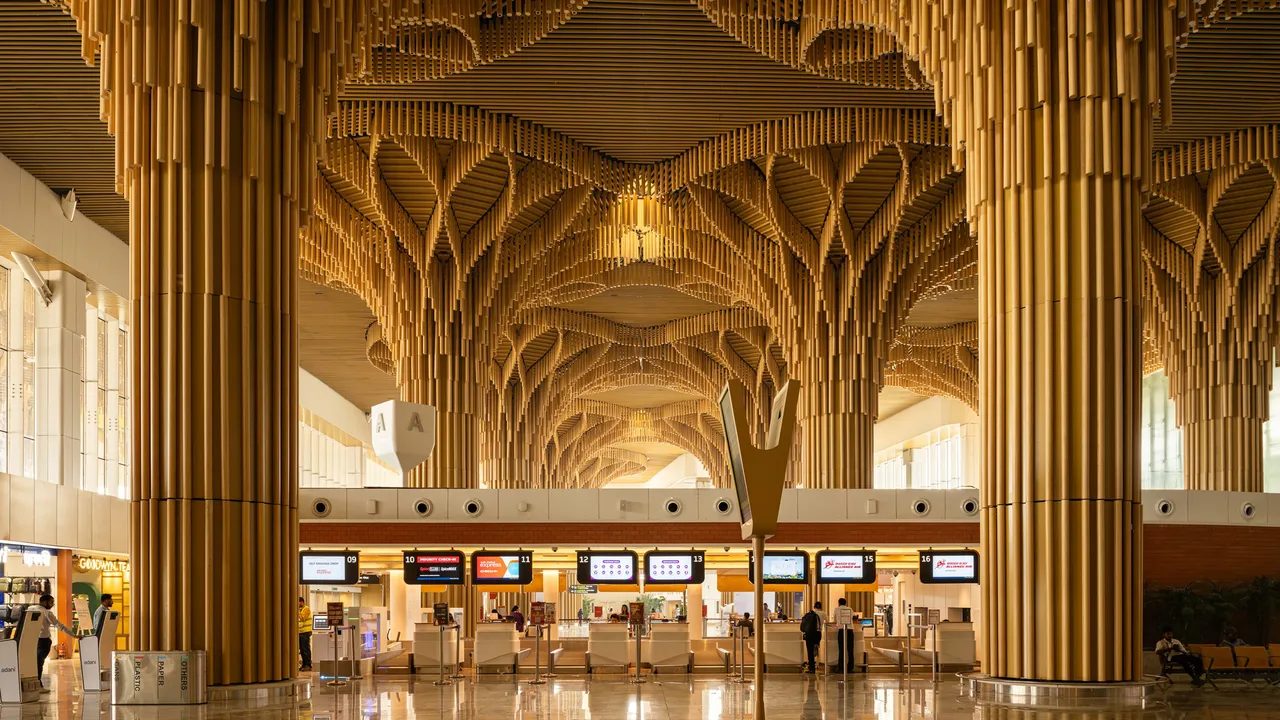
In Guwahati, northeast India, the bamboo orchid flower inspired the design of Lokapriya Gopinath Bardoloi International Airport's Terminal 2. Its central feature is a "sky forest" of sweeping vaulted ceilings with branching structures that echo the region's dense vegetation. The overhead patterns trace the path of the Brahmaputra River, and the interior integrates Indigenous art and tribal stories into waiting areas and lounges.
Navi Mumbai International Airport's Terminal 1, completed in 2025, employs a lotus motif throughout. Designed by Zaha Hadid Architects, the terminal's canopy resembles the flower opening with morning light, with petals appearing to float above the building. The project required redirecting rivers, moving high-voltage power lines, and reshaping terrain—a significant engineering undertaking.
European and North American Entries
Frankfort Airport's Terminal 3 treats passenger movement as urban navigation, with architect Christoph Mäckler arranging spaces to resemble streets, plazas, and neighborhood squares. Three vast rotating rings made from colored aluminum hang overhead, changing appearance as travelers pass beneath them.
Techo International Airport in Phnom Penh, Cambodia, designed by Foster + Partners, features an undulating canopy inspired by traditional palace and temple rooflines. Interior ceilings echo traditional basketry, filtering daylight while reducing reliance on artificial lighting. Native rumduol trees—Cambodia's national flower—grow through the soaring central space.
Pittsburgh International Airport's roof rolls and folds to echo the Allegheny Mountains beyond the city. Thirty-eight steel columns branch into a man-made forest beneath the terminal roof. The design, by Gensler and HDR in association with Luis Vidal + Architects, incorporates local artwork including a "Petal Tunnel" inspired by the Fort Pitt Tunnel, where the city's skyline suddenly becomes visible.
San Diego International Airport rounds out the list with a glass-wrapped waterfront gateway design.
Why the Shift Matters
Jérôme Gouadain, Secretary General of the Prix Versailles, described contemporary airports as "innovative, inescapable hallmarks of their regions and their eras." He noted that these terminals resolve the tension between speed requirements and meaningful place-making—allowing travelers time in spaces that function as more than transit points.
The judges emphasized that the selected airports balance modular functionality, which allows spaces to evolve with changing passenger numbers and technology, with distinctive cultural and environmental references. Three of the seven projects will receive additional awards for interior or exterior design later in 2026.