
The office didn’t just happen—it was built into America’s social fabric
The modern American office emerged from industrial capitalism's need to manage exploding information flows. What began as tedious clerical work became the cornerstone of middle-class mobility, despite its documented toll on workers' minds and bodies.

The American office has roots in violence and desperation. In 1841, John Colt, author of a popular bookkeeping manual, bludgeoned a printer named Samuel Adams to death in a Manhattan office over a disputed $1.35. Twelve years later, Herman Melville was still pondering the murder. His conclusion: the office itself drove Colt to it—a place "entirely unhallowed by humanizing domestic associations."
That murder marked the beginning of something larger. The office wasn't inevitable; it was constructed, brick by brick, into the foundation of American capitalism.
Industrial production, steam-powered transportation, and expanding trade created an unprecedented problem: managing enormous flows of information. Young men, mostly from rural areas, migrated to cities to become clerks, bookkeepers, and copyists. By 1855, clerks ranked as the third-largest category of workers in New York City. They kept accounts, tracked commodities, and recorded documents—tedious, repetitive work that fundamentally rewired how labor was organized.
The shift unsettled 19th-century America. In 1861, Thomas Wentworth Higginson wrote in The Atlantic that "all hand-work is constantly being transmuted into brain-work." In a society that had long measured labor by physical production, desk work seemed inherently unmanly. Higginson worried these "artisans of the brain" would become "dandies," weaklings unfit for the nation. The psychological toll matched the physical concern. After hours at a desk, Higginson observed, the average clerk "leaves his place of business at nightfall with his head a mere furnace of red-hot brains and his body a pile of burnt-out cinders."
Diaries from the first generation of clerks, analyzed by scholar Thomas Augst, corroborate this despair. One entry reads: "Everything is at its highest pitch of dullness. No life in anything, but all seems as inanimate as lifeless matter."
But office work persisted. Technology didn't ease the burden—adding machines, mimeographs, punch cards, and computers simply accelerated information processing. In Sinclair Lewis's 1917 novel The Job, the heroine Una recognizes the pattern: "She knew that the machines were supposed to save work. But she was aware that the girls worked just as hard and long and hopelessly after their introduction as before."
The office also engineered a new gender hierarchy. By the late 19th century, typing, filing, and stenography became women's work, creating a secretarial class with severely limited advancement. Yet for all the tedium and exploitation, office work became the primary engine of social mobility. For men, white-collar jobs offered pathways to status and affluence. For women, despite real constraints, the office provided financial independence and public standing previously unavailable.
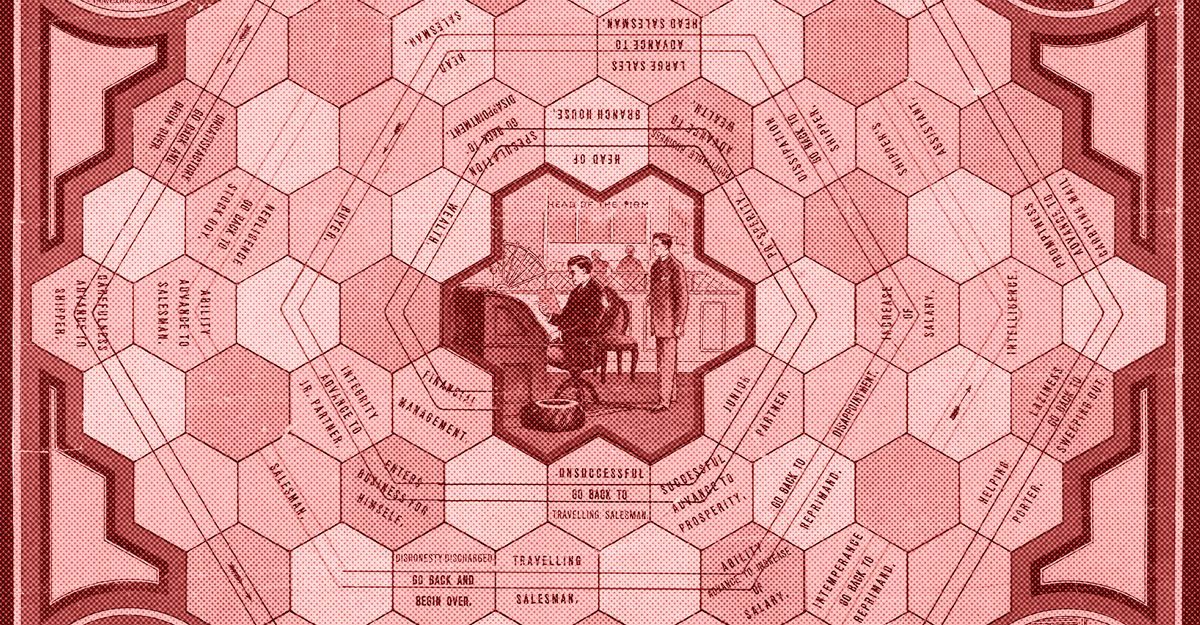
This narrative of upward mobility was embedded in popular culture. In 1889, Parker Brothers released the board game Office Boy. Players began at the margins and moved toward "Head of the Firm" by exhibiting virtues like promptness and diligence. The message was unambiguous: your future depended on your own effort. With luck and determination, you could become the boss.
Today, that framework remains largely intact. The white-collar workplace is widely understood as the most reliable path to middle-class stability and status. The office, born from industrial necessity and refined through waves of technological change, became not just inevitable but aspirational—a space of alienation that millions actively pursue.