
PsiQuantum’s Light-Based Quantum Computer Enters Critical Testing Phase
PsiQuantum is building a quantum computer using photons of light, backed by $1 billion in funding and partnerships with chip manufacturers. The company aims to prove its approach works within the next year.

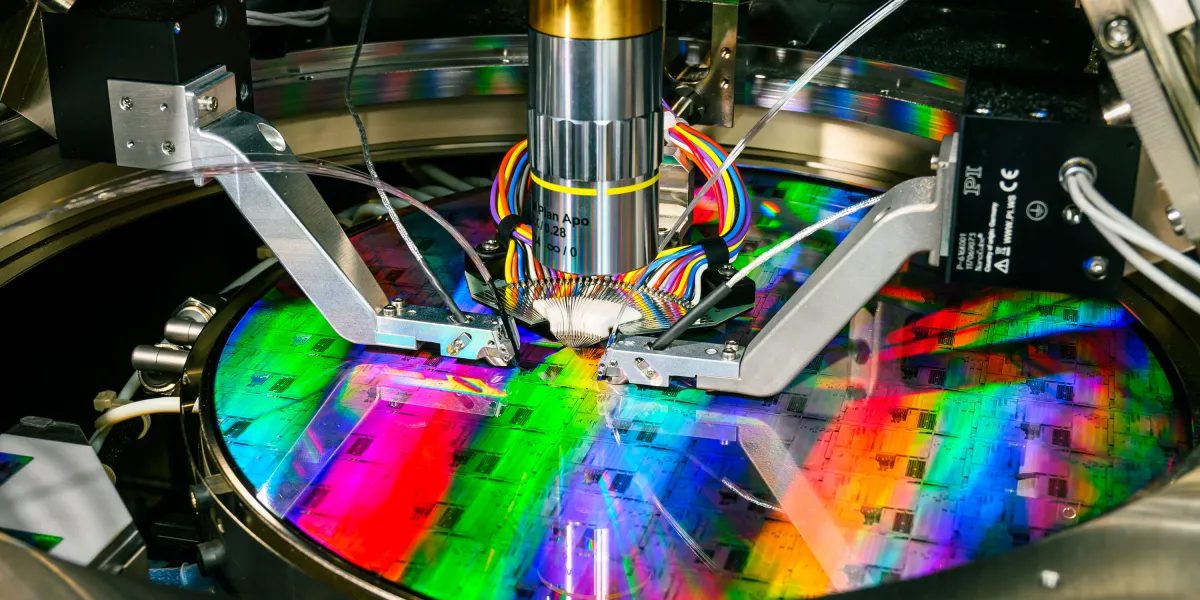
PsiQuantum, a quantum computing startup founded in 2016, is constructing a quantum computer that manipulates particles of light rather than traditional qubits. The machine, expected to occupy roughly 100 refrigerated cabinets connected together and kept near absolute zero, represents an attempt to solve problems conventional computers would take millions of years to address.
The company's approach has attracted unusual credibility in a crowded field. It raised $1 billion in funding last year, broke ground on a facility in Chicago in partnership with local governments, and is building a second site in Australia slated to be hardware-ready in 2027. PsiQuantum is one of only two companies—alongside Microsoft—to advance to the third stage of a U.S. government evaluation program assessing which quantum ventures might deliver practical results.
What sets PsiQuantum apart is its partnership with a major chipmaker to manufacture its photonic systems using existing semiconductor fabrication plants. Rather than building entirely new infrastructure, the company is leveraging established industrial processes to scale production, a pragmatic choice that separates it from competitors pursuing more experimental approaches.
The company's co-founder and chief scientific officer is Pete Shadbolt, one of four physicists from UK universities who launched PsiQuantum. The team divided responsibilities: Terry Rudolph handled theoretical physics, Mark Thompson took engineering, Shadbolt focused on scaling, and Jeremy O'Brien worked on strategy and funding before being replaced as CEO by Victor Peng, a semiconductor industry veteran, in February.
PsiQuantum's specific claim involves dramatically accelerating drug development. The company states that modeling how cytochrome P450 enzymes break down drugs in the human body—work that currently requires over 10 years using conventional methods—could be reduced to four minutes on its quantum machine. Such speed improvements would apply broadly to any process governed by quantum mechanics: battery failure prediction, material corrosion rates, and molecular design.
The fundamental advantage of quantum computers lies in their ability to model quantum systems directly. Classical computers struggle with quantum problems because particles exist in multiple states simultaneously, creating combinatorial complexity that explodes exponentially. Current approximations and simulations force scientists to rely on animal testing or incomplete models. A quantum computer capable of manipulating and measuring thousands of photons could simulate atomic and molecular behavior that reflects reality rather than abstract approximations.
However, translating theoretical potential into practical utility remains unproven. Today's best quantum prototypes remain too small and error-prone to accomplish anything commercially viable. Each photon in PsiQuantum's system must be precisely accounted for and measured as it travels through optical switches and beam splitters—a measurement accuracy challenge that has plagued quantum computing efforts for decades.
PsiQuantum's critical test arrives soon. The company has spent years in closed-door development backed by hundreds of millions in investment. According to reports, results could emerge as early as next year, determining whether the company's engineering translates its theoretical framework into a functional machine. The quantum computing sector has produced no shortage of bold promises; PsiQuantum's next phase will reveal whether its specific bet on photonic systems can deliver where others have stalled.