
NASA’s Roman telescope will use shape-shifting mirrors to spot Jupiter-like exoplanets
NASA's Roman Space Telescope will deploy shape-shifting mirrors to suppress starlight and detect mature Jupiter-like exoplanets—a capability that could open a new chapter in direct exoplanet imaging when the telescope launches next month.

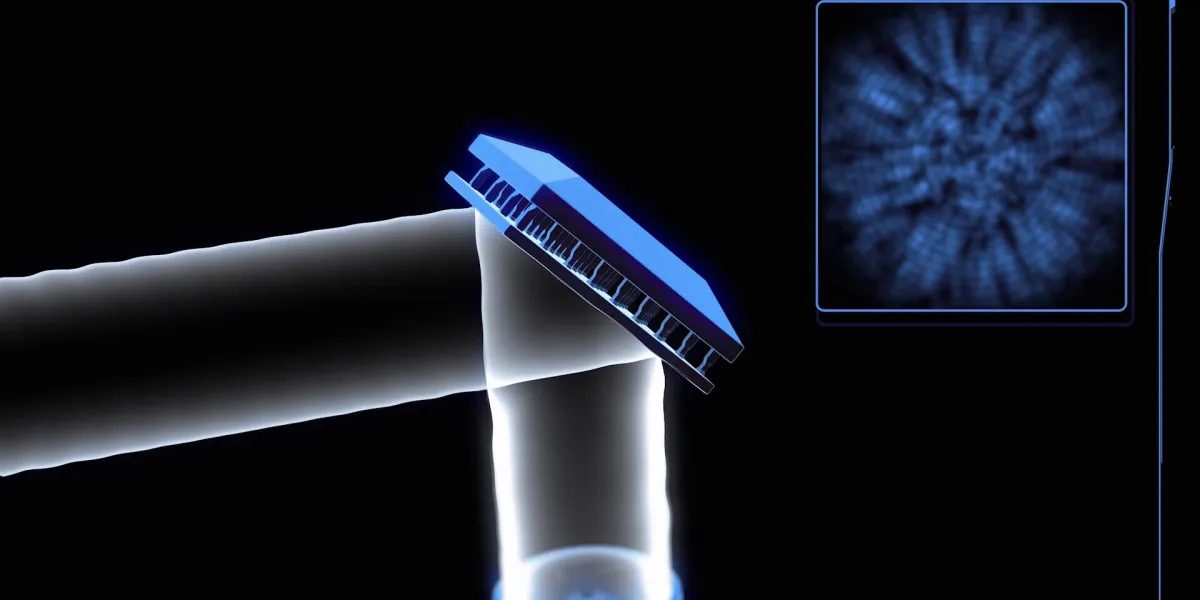
NASA's Nancy Grace Roman Space Telescope, launching as early as August 2026, will carry the first space-bound active coronagraph—an instrument that uses deformable mirrors to suppress starlight and reveal faint exoplanets orbiting nearby stars.
Unlike earlier coronagraphs aboard Hubble and the James Webb Space Telescope, which rely on fixed masks to block stellar glare, Roman's system measures leftover light before each observation and actively cancels it out. The telescope contains two deformable mirrors, each with a 48-by-48 checkerboard of tiny actuators (pistons) beneath a thin glass sheet. When voltage is applied, these actuators contract and shift their patches of mirror by up to 0.5 micrometers—about one-fourth the size of an E. coli bacterium—in increments as small as 10 picometers, roughly a tenth the diameter of a hydrogen atom.
This approach creates what engineers call an "active wavefront," where each mirror component positions itself to cancel incoming waves of unwanted light, similar in principle to noise-canceling headphones but for photons. According to Ilya Poberezhskiy, the instrument's project systems engineer at NASA's Jet Propulsion Laboratory, the system will generate a "doughnut-shaped region around the star where we suppress starlight and where we're hoping to see exoplanets."
The sensitivity gain is substantial. Compared with current space-based coronagraphs, the active system is expected to improve detection sensitivity by a factor of up to 1,000, revealing planets far too faint to observe with existing telescopes.
Roman will also use optical masks, including "silicon grass"—microscopic spikes that trap photons rather than reflecting them back toward the detector. These layers work in succession to guide preserved planetary light toward the final sensor.
The practical payoff lies in direct imaging of mature gas giants. Nearly all exoplanets photographed to date are young, oversize worlds—several times Jupiter's mass, still radiating heat from their formation—orbiting far from their host stars. They are easy to see precisely because they glow brightly in infrared.
Roman could change that by directly imaging a true Jupiter analogue: a planet similar in mass to Jupiter, orbiting a sunlike star a few times farther out than Earth orbits our sun, and cooled after billions of years. Such planets have only been detected indirectly, through the gravitational wobble they cause in their parent stars.
"We're not looking at the star. We're not looking at the effect of the planet on the star," says Meredith MacGregor, professor of astronomy at Johns Hopkins. "We are actually looking at the planet, and that is super powerful."
Roman will not resolve such planets into solid disks—at best, they will appear as clusters of pixels. However, this resolution suffices to measure the wavelengths of light reflected from the planet, providing data on atmospheric chemistry and, by extension, hints about surface conditions and habitability.
Brandon Creager, the instrument's lead mechanical engineer at JPL, frames Roman as a stepping stone toward future missions. "I hope it's remembered for it being that critical stepping stone for … finding Earth 2.0," he says.
The telescope itself carries a roughly 300-megapixel wide-field camera enabling images about 100 times larger than Hubble's widest exposures at comparable resolution. Beyond exoplanet imaging, Roman is designed to detect approximately 100,000 new exoplanets through indirect methods and help astronomers probe dark matter and dark energy.
Javier Viaña, a research scientist at Harvard with two projects selected for Roman's competitive first year of observations, compares the leap to moving from "interviewing a handful of people" to "conducting a global census."
Scientists acknowledge the challenge ahead. "I'm honestly a little terrified about how we're all going to deal with it, because I think it's just so much data," MacGregor says. "I think people will legitimately still be working on Roman data for decades."