Everything Circulates: Ham Yang-ah’s New Exhibition Explores Systems, Death and AI at Seoul’s Art Sonje Center
Ham Yang-ah's new exhibition at Seoul's Art Sonje Center weaves death, birth, political history and AI into a 22-minute meditation on systems and humanity's future.

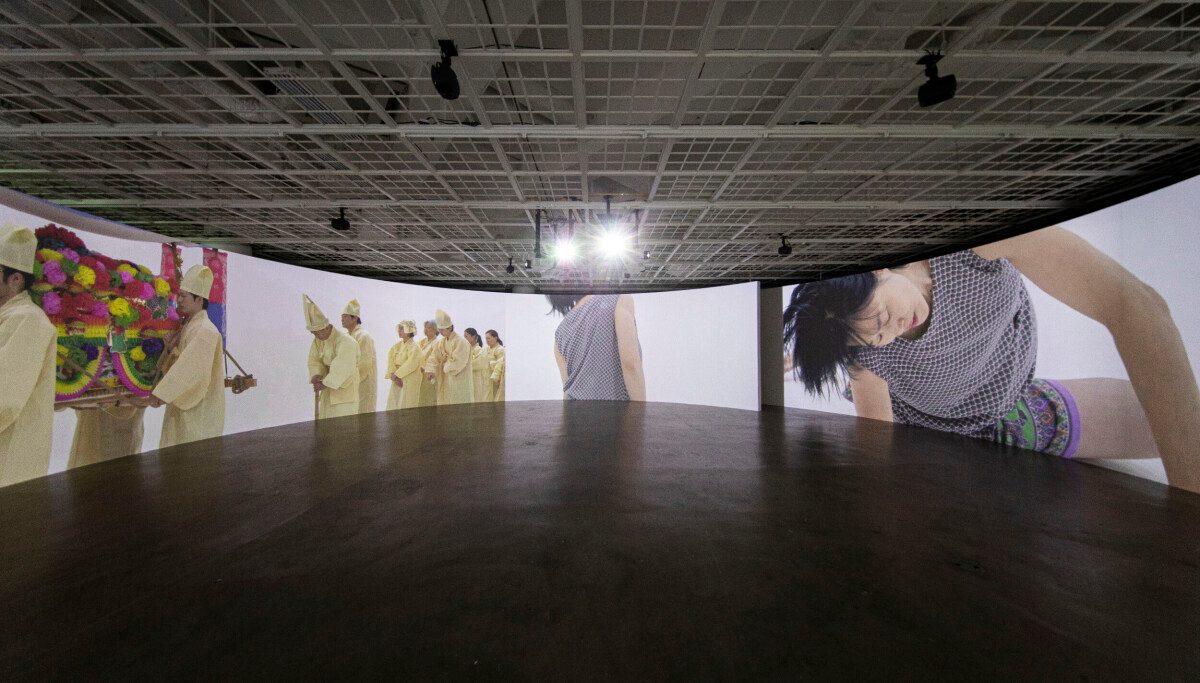
Artist Ham Yang-ah opens her exhibition "Undefined Panorama" at the Art Sonje Center in central Seoul with a deceptively simple image: ash scattered into the sea. By the final frame, water dissolves into pixels of data. In between lies an eight-chapter, 22-minute video journey through death rituals, birth, Margaret Thatcher's rise to power, the 2008 financial crisis and the logos of artificial intelligence companies circling an LED screen.
It is Ham's first solo show at the venue in 16 years. The eight-year research project underpinning the work examines systems, histories and futures—what she calls an "indramang," drawing on Indra's Net, an Eastern philosophical metaphor for infinite connectedness.
"Everything circulates, but it always isn't a cycle that repeats and comes back to the same place," Ham explained at a press conference on Thursday. "We have lived through the Industrial Revolution, then the revolution of financial capitalism, and now we're inside the digital one. I'm asking what our future becomes from there."
Weaving the Personal and Political
The exhibition's structure moves between intimate and macro scales. "Undefined Panorama 4.0" opens with Chapter 1: the cremation and scattering of ashes, followed by footage of a grave being exhumed—Ham's own grandmother's grave, filmed as part of the work. A performance of funeral and birth follows, holding death and life within a single cycle.
The middle chapters accelerate through recent history. Thatcher's 1979 rise appears as the moment neoliberal theory entered practice. Ronald Reagan, the Berlin Wall's fall, the Soviet collapse and the 1990s homogenisation of global culture via Windows and McDonald's arrive in rapid succession. "Up to then, people had thought communal life and communal meaning mattered," Ham noted. "Then we entered a period where everyone had to survive on their own."
By Chapter 4, the work captures 2008, the Occupy movement, the Arab Spring and Covid-19. Chapter 6 reaches the present and moves forward. Two groups of figures occupy opposite arcs of a ring installation: one accelerates, the other slows. Between them, AI and tech company logos cycle continuously.
The Question of the Future
Chapter 7 poses the exhibition's central tension. "The question is whether it shows solidarity, a bond between people—or whether individuals in a future society exist only as data suppliers excluded from policy and from anything that actually matters," Ham said. "That might be what the human future looks like."
The broader exhibition includes Ham's archive: "Undefined Panorama 2.0" (2019) opens on Dolly the cloned sheep and the government structures behind her. "The Sleep" (2015-16), a response to the 2014 Sewol ferry tragedy, lays bodies across a gymnasium floor, depicting victims' families, onlookers and the systems that shelter and control them simultaneously.
When asked about her own work, Ham acknowledged her ambition borders on the absurd. "I read the description that I had written myself of this work, and even though I wrote it, I found it absurd," she said. "So I asked myself—what is this actually saying? I keep asking, and I imagine I'll keep asking."
"Undefined Panorama" runs through 4 October. Admission for adults is 10,000 won (approximately $7).