Vance’s Strategic Stumbling: Why a Yale-Educated VP Performs Incompetence
Vice President J.D. Vance performs incompetence strategically, feigning ignorance on documented facts while maintaining contempt for supporters he publicly patronizes. His intellectual trajectory contradicts his deliberate public stumbling.

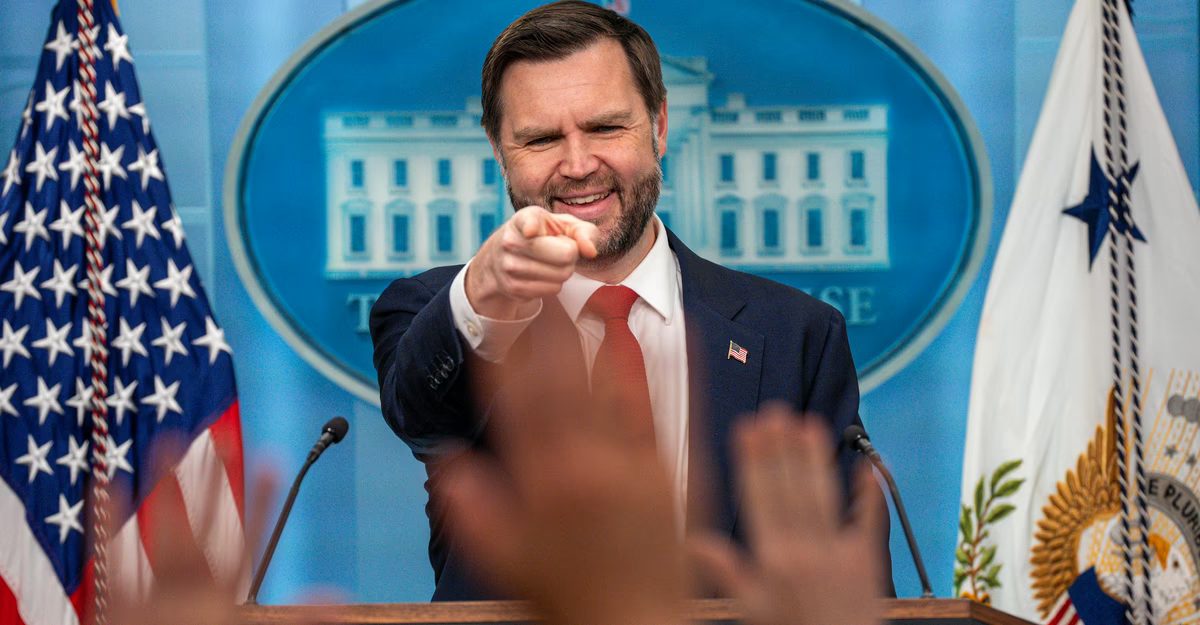
Vice President J.D. Vance is not intellectually limited. His trajectory—from poverty to Ohio State honors to Yale Law School—demonstrates the kind of disciplined ascent that requires intellectual appetite. Classmates recall a young man with broad interests and genuine curiosity, including a close friendship with a transgender law school peer. Yet in 2026, Vance has built a public persona around feigned ignorance and strategic confusion.
The pattern is unmistakable. In a recent Joe Rogan interview, Vance claimed bafflement when a UFC fighter at a White House event called Michelle Obama a man, prompting Rogan to supply the obvious explanation. In June, Vance acted unaware that Democrats vote by mail at higher rates than Republicans—a phenomenon so well-documented it has a name: the "blue shift." In May, at a White House briefing, he argued that congressional Democrats' applause for King Charles III proved "No Kings" rallygoers were hypocritical about Trump's policies, with apparent sincerity.
This is not clumsiness. These moments follow a consistent logic: Vance adopts positions his supporters likely hold, then performs confusion about counterarguments. In 2025, he told Theo Von's podcast audience that expecting all Confederacy fighters to be viewed as evil was "stupid"—a characterization of a debate no major figure actually conducts. The actual argument, across academia and policy, centers on whether monuments to a slavery-defending rebellion belong in public spaces and whether military bases should bear traitors' names. Vance's framing obscures rather than engages.
When confronted about spreading false claims regarding Haitian immigrants in Springfield, Ohio, Vance acknowledged the falsehoods but defended them as tools for amplifying administration immigration messaging. His reasoning was transparent: the claims worked rhetorically, regardless of accuracy.
The intellectual architecture underlying these performances reveals itself in Vance's own words. On Rogan's show last week, he distinguished between authentic populism and what he calls "faux populism." The latter, he explained, operates "by assuming that they're idiots and acting like they're idiots." This was less confession than blueprint—a public articulation of his operating principle.
Vance's earlier self understood the trap he now springs. In a 2016 Atlantic essay written before his political alignment with Trump, he critiqued the "demagogic tendency to condescend to people in so-called flyover country," his own birthplace. Such condescension, he wrote then, viewed rural Americans as easily manipulated through "simplistic talking points and grievance plays." The problems those communities faced "demand serious thought and measured action—from governments, yes, but also from community leaders and individuals." Trump's approach, Vance argued, co-opted legitimate grievances cynically while offering no substance.
That analysis was cogent. This Vance has inverted it entirely, now performing the exact intellectual condescension he once condemned.
The political calculus appears deliberate but shows cracks. Vance's approval ratings have remained underwater for over a year. When pollster Sarah Longwell conducted focus groups with Trump voters, Vance registered as notably unpopular even among that core constituency. His two electoral victories—both Senate and vice presidency—derived principally from Trump's political machinery rather than his own coalition-building.
Historically, politicians who pander successfully do so with subtlety; the best disguise artifice. Vance's versions are conspicuous enough that voters notice the disdain. His occasional tactical missteps—photo ops that visibly strain him, public arguments that collapse under minimal scrutiny—suggest someone uncomfortable with sustained performance of a character misaligned with his demonstrated capabilities.
What remains unclear is whether this strategy serves Vance's long-term positioning. It keeps him aligned with Trump's base expectations in the short term while producing measurable voter skepticism. The tragedy, as observers note, lies not in that he adopted the persona—political calculation is standard—but in how thoroughly he abandoned the intellectual seriousness that once distinguished him, in favor of performances that telegraph contempt for the audience he claims to represent.